
Sometimes the ADHD tax is a $12 subscription you forgot to cancel. Sometimes it’s a notice on your front door—and the terrifying realization that you might lose your home.
Sometimes it’s walking outside and finding your car gone.
Sometimes it’s opening your bank account and seeing that the money you needed for groceries has already disappeared into automatic payments, overdraft fees, and purchases you barely remember making.
We talk about the ADHD tax like it’s a funny little inconvenience.
The lettuce that turned into soup in the refrigerator.
The third pair of sunglasses because the first two vanished.
The free trial that quietly became a committed relationship.
And yes, those things add up.
But there is a much heavier version of this conversation.
The one involving missed mortgage payments. Repossession. Debt you’re afraid to look at. A partner asking, “How did it get this bad?” when you’re already asking yourself the same thing.
That conversation deserves room, too.
When “I’ll deal with it tomorrow” gets expensive
Picture an envelope sitting on the kitchen counter.
You know it matters. You moved it somewhere visible specifically because it matters.
But opening it might mean finding out you owe money you don’t have. It might mean making a phone call. Finding a password. Explaining something embarrassing. Making a decision you don’t feel ready to make.
So you tell yourself you’ll open it after dinner.
Then tomorrow.
Then when you get paid.
Eventually, the envelope becomes something you avoid looking at while making coffee.
The problem is still there. Now it has more time to grow.
For some women with ADHD, that gap between knowing something needs attention and being able to start is painfully familiar.
You can care deeply about keeping your home and still struggle to open the mortgage notice.
That contradiction is hard to explain from the outside. It can be even harder to live with.
The car payment isn’t always just one task
“Just pay the bill” sounds simple.
Until paying the bill means:
- Remembering which company handles the loan.
- Finding the login.
- Resetting the password.
- Checking your balance.
- Figuring out which other payment will come out first.
- Facing the possibility that there isn’t enough money.
Now you’re overwhelmed before you’ve even reached the payment screen.
And if you’ve already missed a payment, there may be another layer: shame.
You don’t want to hear how late you are. You don’t want to explain. You don’t want someone to ask why you didn’t call sooner.
So you avoid the call.
The consequences keep moving even while you feel stuck.
Sometimes you had the money. Sometimes you didn’t.
These are different situations, and both deserve honesty.
Sometimes the money was there, but the deadline slipped past you.
Sometimes an unexpected charge pulled money out of the account you thought was covered.
Sometimes you spent money impulsively and now have to face what that means for the bills.
And sometimes there simply wasn’t enough income to cover the essentials.
A budgeting tool cannot create money that isn’t there.
We need to stop treating every financial crisis like it could have been prevented with a prettier planner.
But when forgotten dates, scattered information, or avoided tasks are part of the problem, a simpler system can give you a place to start.
Shame makes it harder to look
There’s a particular kind of shame that comes with losing money in a way you think you “should have” prevented.
You replay every purchase.
You think about what else that late fee could have paid for.
You promise yourself you’ll become a completely different person next month: organized, disciplined, suddenly excited about spreadsheets.
Then the new system requires daily tracking, twelve categories, and a Sunday review that takes an hour.
You miss a week.
Opening the planner starts to feel like opening the overdue notice.
You need a system you can return to after missing a week. Because missing a week should not mean abandoning the whole thing.
Start with what needs protecting
If you’re overwhelmed, you don’t have to begin by categorizing every purchase from the last six months.
Begin with three questions:
What money is available right now?
What essential payment needs attention next?
What is the smallest action I can take today?
That action might be opening one notice.
Checking one due date.
Writing down the number you need to call.
Asking someone you trust to sit beside you while you make that call.
If you’re facing foreclosure or repossession, a worksheet alone is not enough. Getting in touch with your lender or servicer and seeking qualified local support needs to take priority over making your budget look finished.
You can bring an unfinished page to that conversation.
You can ask for help before you have a perfect explanation.
Why I made A Little Money Reset
I wanted Unfinished Tasks Co. to have a money tool with room for real life.
Bills. Medication. Groceries. Little joys. Convenience spending on days when you have nothing left. The expense you forgot existed until it showed up again.
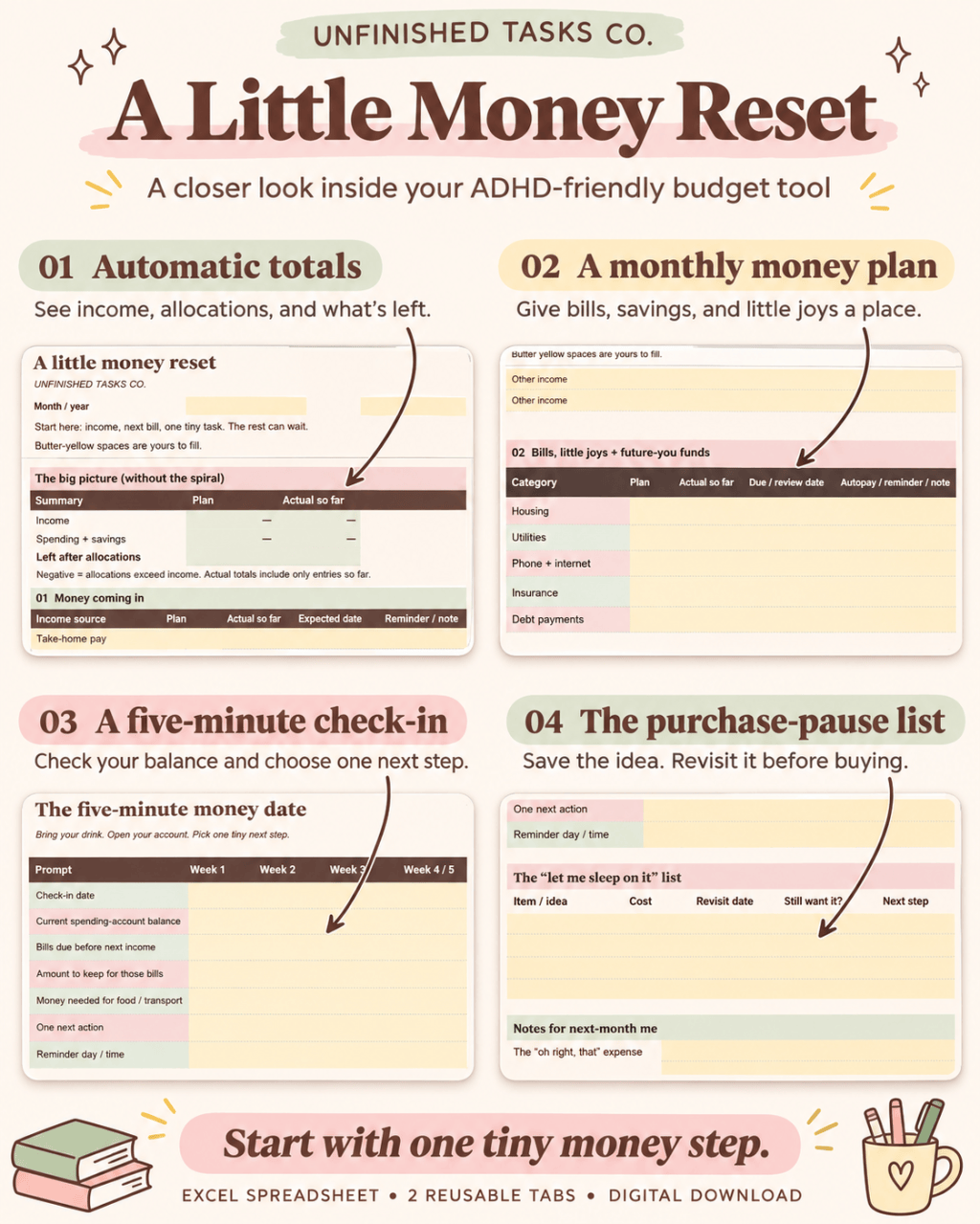
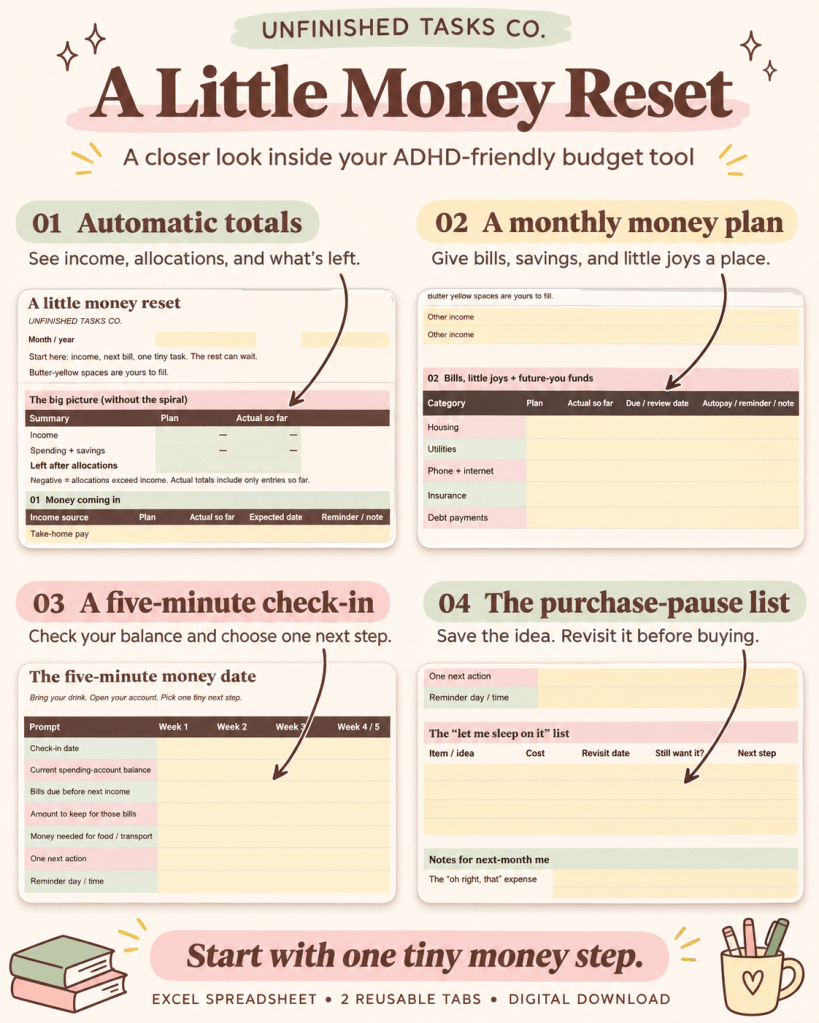
A Little Money Reset includes a monthly budget with automatic totals, a short weekly check-in, and a “let me sleep on it” purchase list.
It gives you somewhere to put the numbers and choose your next step.
It won’t undo a financial crisis. It can help you make checking in with your money a smaller task.
Because whether you’re dealing with another forgotten subscription or something much more serious, you deserve support that lets you tell the truth about where you are.
Even if the bills are late.
Even if you’re scared.
Even if you’ve started over before.
Start with today’s balance. Find the next bill. Take one tiny step.
Explore A Little Money Reset in the Unfinished Tasks Co. store.


Leave a Reply